


The mining industry constantly seeks innovative solutions to optimize operations, enhance efficiency, and minimize environmental impact. A critical aspect of this pursuit is precise ore selection, which directly influences processing performance and overall profitability. Traditional methods often suffer from delays, leading to suboptimal decision-making. In response, Anglo American, in collaboration with Finnish researchers at VTT, has pioneered Active Hyperspectral Sensing (AHS) technology, a breakthrough designed to provide real-time ore intelligence and transform mine planning and processing.
The Challenge of Ore Variability
Orebodies are inherently variable in their geological composition. Accurately characterizing this variability in a timely manner is paramount for effective mine planning and processing. Conventional ore characterization techniques, such as drilling, geological modeling, and laboratory sampling, provide essential data but often involve significant time lags between data collection, analysis, and operational response. These delays can limit the precision of ore selection in the pit, potentially leading to the processing of lower-grade material or the misdirection of valuable ore to waste streams.
Active Hyperspectral Sensing (AHS): A Technological Leap

Active Hyperspectral Sensing (AHS), developed in partnership with VTT, represents a significant advancement over conventional hyperspectral systems. Traditional hyperspectral imaging often struggles in dynamic mining environments due to fluctuating light conditions and operational complexities. AHS overcomes these limitations by employing an actively controlled light source, ensuring reliable sensing directly in the field, regardless of ambient conditions .
The core of this technology, as detailed by Hypermine (a VTT spin-off), involves a laser-based hyperspectral sensor that provides real-time mineralogy data. This system operates 24/7, even in harsh conditions like darkness, direct sunlight, dust, and rain, thanks to its active laser platform that ensures homogeneous illumination of the rock surface. Furthermore, the hardware is pre-calibrated at the factory, eliminating the need for daily on-site calibration, which is a common requirement for passive systems .
Enhancing Ore Control and Value Recovery
Anglo American’s primary goal with AHS is to transition ore control from a reactive to a predictive paradigm. Instead of relying solely on delayed laboratory analyses, AHS enables continuous assessment of ore characteristics directly in-pit, on conveyors, or within processing streams. This real-time data empowers operational teams to make faster, more informed decisions regarding ore routing, dilution reduction, plant feed stabilization, and ultimately, maximizing value recovery from the orebody.
Hypermine’s technology boasts a 100-fold increase in accuracy for ore selection compared to traditional methods. While conventional decision-making is based on 3,000–10,000-tonne averages of block models, AHS allows for unique decision-making for every shovel or truck load, increasing the resolution to 100–300 tonnes of material. This granular data leads to significantly more accurate stockpiling decisions .
The Minas-Rio Case Study
The Minas-Rio iron ore operation in Brazil served as a crucial proving ground for AHS. The presence of alumina-rich clay in the orebody was identified as a key source of variability impacting operational performance. A techno-economic study highlighted a substantial value opportunity for implementing sensing and selective mining techniques to manage this challenge proactively.
Initial test work was conducted at Anglo American’s Sensor Fusion Loop in South Africa, a full-scale testing facility designed to evaluate sensing technologies under real-world operating conditions. Ore samples from Minas-Rio were subjected to multiple sensing approaches in both wet and dry conditions to ascertain the accuracy of identifying problematic high-alumina material .
The results from these initial tests unequivocally demonstrated the effectiveness of AHS in differentiating key ore types from Minas-Rio with high accuracy. This marked a critical milestone, proving the feasibility of real-time ore classification in operational mining environments.
In-Pit Field Demonstrations and the Sensing Pod
The next phase involved determining the technology’s efficacy in the actual mining pit under typical operating conditions. Field demonstrations at Minas-Rio successfully differentiated high-alumina material even under challenging conditions, including bright sunlight and wet, overcast weather. This confirmed AHS’s robustness and ability to perform reliably in the varying conditions of a working mine .
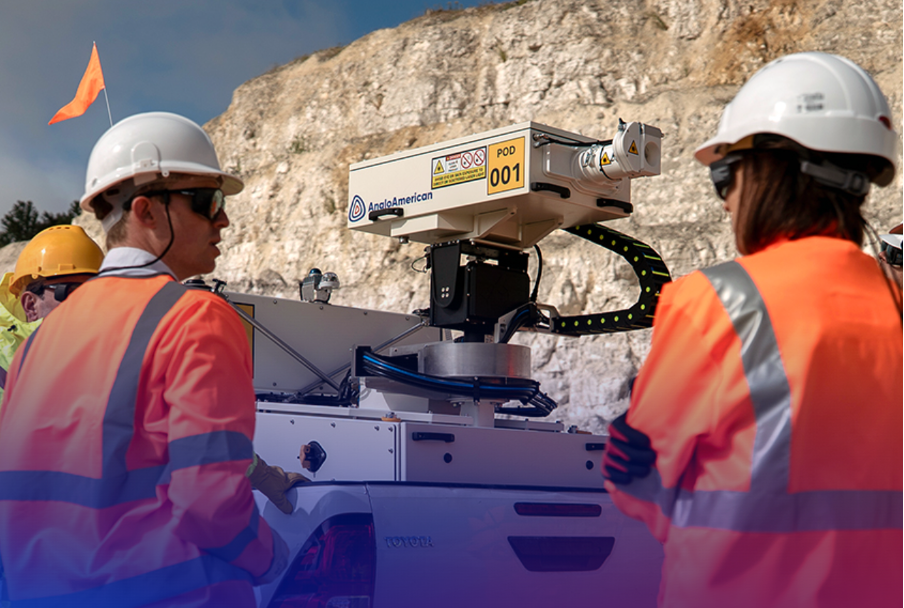
Building on this success, Anglo American embarked on developing a mobile “Sensing Pod.” This innovative unit is designed to scan ore directly in the mining pit, process results in near real-time, and integrate seamlessly with existing mining fleet management systems. A proof-of-concept program is currently underway at Minas-Rio to further evaluate how this advanced sensing capability can support selective mining, improve ore control, and contribute to more stable downstream processing .
Broader Applications and Future Outlook
Anglo American continues to explore broader applications for sensing technologies across various commodities and value drivers. The company views sensing as a new paradigm for understanding orebodies, one that holds the potential to propel mining towards faster, more connected, and more intelligent operational decision-making .
The integration of AHS with machine learning algorithms allows for the real-time delivery of rock type, lithology, chemistry, and ore grade knowledge. This data, combined with 3D LiDAR point clouds and visible images, provides a comprehensive understanding of measured areas, enabling precise mineral data on the edge .
Anglo American’s development and implementation of Active Hyperspectral Sensing technology, in collaboration with VTT and Hypermine, marks a significant leap forward in mining innovation. By providing real-time, accurate ore intelligence, AHS empowers mining operations to optimize ore selection, reduce waste, enhance processing efficiency, and ultimately unlock greater value from their orebodies. This predictive approach to ore control not only boosts profitability but also contributes to more sustainable mining practices by reducing energy and water consumption and minimizing tailings generation. As the industry continues to evolve, technologies like AHS will be instrumental in shaping the future of intelligent and efficient mining.