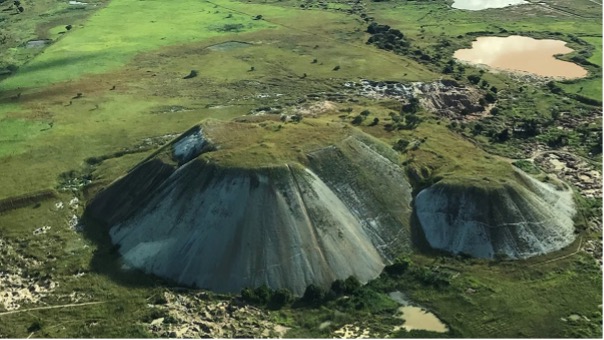
Zijin Mining Group is preparing to open a new lithium mine in the Democratic Republic of Congo this year, a project expected to become one of the largest sources of lithium—a crucial metal used in batteries for electric vehicles and energy storage systems—worldwide.
The Chinese company, which has rapidly expanded to become a leading producer of copper and gold, began developing the Manono lithium project in southeastern Congo after securing the rights to the valuable deposit in 2023.
According to a company report released on March 20, Zijin aims to launch operations at the mine in June, with plans to eventually produce 130,000 tons of lithium carbonate equivalent (LCE) each year. Lithium carbonate equivalent is a standard measurement that allows for easy comparison between different lithium projects, regardless of the specific chemical forms in which their lithium is produced. This output would make Manono one of the world’s largest hard-rock lithium mines, with only a few massive operations in Australia capable of producing more.
Martin Jackson, head of battery materials markets at consultancy CRU Group, explains that this scale positions Manono among the world’s top hard-rock lithium assets. While the report did not specify when the mine would reach full capacity, its eventual output will significantly boost global supplies of lithium—a metal that is essential for manufacturing electric vehicles and energy storage systems. Jackson estimates that by 2028, once fully operational, Zijin’s mine could supply around 5% of the world’s mined lithium.

This increased supply holds significant promise for the electric vehicle industry and global battery manufacturing. By adding such a large new source of lithium, Manono could help stabilise battery prices, which have been volatile due to supply shortages and rising demand. With Zimbabwe, another major African lithium supplier, recently banning exports of lithium concentrate, the entry of Manono’s production comes at a critical moment for the market, potentially easing pressure on global supply chains and supporting the growing transition to electric mobility.
However, the Manono project is not without controversy. Ownership of the mine has been a matter of dispute, with Australia’s AVZ Minerals maintaining it still holds rights to the area. The Congolese government revoked AVZ’s licence three years ago—after the company identified Manono as one of the largest hard-rock lithium deposits—before allocating the northern part of the concession to Zijin. This dispute has led AVZ to start arbitration proceedings in an effort to recover its permit.
Meanwhile, the southern section of Manono has drawn interest from KoBold Metals, a technology-driven exploration firm backed by prominent American investors including Bill Gates and Marc Andreessen. This interest highlights the broader geopolitical significance of the region, as the United States seeks to strengthen mineral partnerships with Congo and secure critical resources for its own industries. In fact, reports indicate that US officials have encouraged AVZ to sell its stake in Manono to an American company, which could then develop an additional mine.
As Zijin moves forward, the company expects the Manono mine, which cost $1.4 billion to build, to produce between 850,000 and 875,000 tons of lithium concentrate annually at full capacity. Lithium concentrate is a semi-processed material that must be further refined before it can be used in batteries. Industry experts like Chris Williams of Adamas Intelligence note that this intermediate step is vital, as only refined lithium compounds are suitable for modern battery production.
To facilitate this process, Zijin is building a smelter expected to be ready by the end of the year. This facility will convert about 500,000 tons of concentrate annually into an intermediate lithium sulfate product, which is another step on the way to producing battery-grade lithium. These efforts are designed to make the most efficient use of Manono’s resources and ensure a steady supply of value-added materials for the global battery market.
Ownership of the Manono project is currently split, with Zijin holding almost 55% and the Congolese state the remainder. This partnership, along with Zijin’s other investments in Congolese copper mines—such as its 39.6% stake in the Kamoa-Kakula complex—reflects China’s growing influence in Africa’s mining sector and the global race to secure critical minerals.
Zijin’s rapid expansion strategy has also made it a leading gold producer, with projects spanning China, Central Asia, Africa, Australasia, and South America. The company’s presence in Africa is especially noteworthy as the continent, led by countries like Zimbabwe, has become a key supplier of lithium to China’s battery industry. If Mali’s Goulamina project is expanded as planned, it could surpass even Manono in size, according to Adamas Intelligence.
In summary, the opening of Zijin’s Manono lithium mine marks a pivotal moment for the global battery supply chain. By substantially increasing the world’s lithium output, the project could help meet rising demand, stabilise prices, and shift the balance of power in the international race for battery minerals—all against a backdrop of ownership disputes, new partnerships, and shifting export policies.